
Practical help for building a better enclosure.
Species guides, equipment explanations and simple answers about custom backdrops, hides and habitat features. Start with whatever question you are trying to solve.
What are you trying to work out?
Search the guides or jump into a topic. You do not need to know the right reptile-keeping jargon first.
Enclosure ideas by species.
These guides explain how different animals use their space and where custom features such as ledges, hides, branches and backdrops can actually be useful.
Bearded dragon enclosure guide
Basking areas, climbing routes, hides, lighting space and ways to make better use of the back wall.
Read guide →BLUE-TONGUEBlue-tongue enclosure guide
Floor space, low hides, basking areas, substrate depth and scenery that does not crowd a ground-dwelling skink.
Read guide →CARPET PYTHONCarpet python enclosure guide
Strong climbing routes, branches, elevated resting areas, hides and access for a larger semi-arboreal snake.
Read guide →CHILDREN'S PYTHONChildren's python enclosure guide
Secure hides, compact climbing opportunities, heating zones and ways to add structure without overcrowding the tank.
Read guide →GREEN TREE FROGGreen tree frog enclosure guide
Vertical perches, plants, clean water, misting, drainage and places to hide during the day.
Read guide →KNOB-TAILED GECKOKnob-tailed gecko enclosure guide
Deep substrate, low hides, humid retreats and desert-style scenery designed around a small ground-dwelling gecko.
Read guide →Know what the gear is doing before you buy it.
Our new equipment desk separates Oddball-made habitat pieces from specialist gear such as thermostats, UVB, heating and monitoring.
Bearded dragon complete setup
See how custom habitat pieces, heating, UVB, control and monitoring fit together before the enclosure is built.
Open setup guide →Equipment hub · buying guidesReptile equipment desk
A practical starting point for thermostats, heating, UVB and temperature/humidity monitoring.
Browse equipment guides →Control · safety · compatibilityReptile thermostats explained
Dimming, pulse proportional and on/off control — and why the heater type matters.
Read thermostat guide →Lighting · UVB · layoutUVB lighting planning
Plan lamp output, distance, obstruction and service access before permanent scenery goes in.
Read UVB guide →Heating · gradients · controlReptile heating explained
Build a usable warm-to-cool gradient rather than simply making the enclosure hot.
Read heating guide →Monitoring · probes · surfacesThermometers & hygrometers
Verify the conditions the animal actually experiences with the right type of measurement.
Read monitoring guide →Some equipment guides contain clearly labelled affiliate links. How Oddball handles recommendations →
Small terrariums. Serious little design problems.
Australian-first guides for commonly kept and niche invertebrates, plus micro backdrops and accessories built around moulting, burrowing, webbing and escape-proof access.
Invertebrate terrarium guide hub
Choose the animal first, then build around how it climbs, hangs, webs, burrows or hides.
Browse invertebrate guides →COMMON STARTERSpiny leaf insect enclosure
Moulting height, airflow, food branches and tiny-hatchling containment.
Read guide →MICRO SPIDERJumping spider terrarium
Vertical hunting surfaces, web retreats and escape-proof micro structure.
Read guide →PREDATORY INSECTPraying mantis enclosure
Overhead perches, clear moult drops and live-prey access without clutter.
Read guide →NICHE INSECTGiant burrowing cockroach setup
Substrate, leaf litter and hardscape that cannot be undermined by digging.
Read guide →EXPERIENCED KEEPERAustralian tarantula enclosure
Secure lids, burrow-friendly structure, legal sourcing and tool-first maintenance.
Read guide →EXPERIENCED KEEPERAustralian scorpion enclosure
Burrowers versus crevice dwellers, stable hardscape and containment.
Read guide →AUSTRALIA-SPECIFICLegal sourcing & keeping rules
Why overseas species lists do not apply here and where to check current local rules.
Read guide →CUSTOM MICRO HABITATSMicro backdrops & accessories
Thin textured panels, branch mounts, burrow starters, tiny hides and one-off terrarium pieces.
See what we can make →Build the habitat as a system.
Seven practical, Australia-first guides covering substrate, bioactive builds, airflow, quarantine, maintenance and equipment safety—with custom help where it genuinely adds value.
Plan a reptile habitat as a system — not a shopping list
An Australia-first framework for planning reptile heat, UVB, ventilation, substrate, cleaning and quarantine before buying equipment.
Read guide →BIOACTIVE PLANNINGBioactive reptile enclosures in Australia: what “working” actually means
A practical Australian guide to deciding whether a bioactive reptile enclosure is suitable, maintainable and safe for the animal and keeper.
Read guide →MATERIALS DECISIONChoosing reptile substrate in Australia without chasing one “best” product
A decision-led Australian reptile substrate guide covering species behaviour, moisture, ingestion risk, cleaning, quarantine and bioactive use.
Read guide →ENVIRONMENTAL CONTROLReptile enclosure ventilation and humidity: design the relationship
Plan reptile enclosure ventilation and humidity together, with practical Australian room-climate, monitoring and maintenance considerations.
Read guide →NEW ANIMAL PROTOCOLA practical reptile quarantine enclosure: simple enough to observe
Plan a practical reptile quarantine enclosure with separable equipment, visible waste, secure housing and veterinarian-led escalation.
Read guide →MAINTENANCE SYSTEMA reptile enclosure cleaning schedule that protects the habitat
Build a practical reptile enclosure cleaning schedule around daily observation, targeted cleaning, equipment checks and material compatibility.
Read guide →FREE PRINTABLE CHECKLISTReptile heat and lighting safety checklist
A printable Australian reptile enclosure preflight checklist for heaters, thermostats, probes, UVB, cables, monitoring and post-change verification.
Read guide →Small pets deserve serious habitat design.
Australian-first housing, heat, enrichment and soft-goods guidance—connected to genuine Oddball-made products where they solve the right problem.
Small-pet habitats that support real behaviour
Australian habitat planning for guinea pigs, rats and mice, including housing, enrichment, heat safety, hammocks and easy-clean custom pieces.
Read guide →SMALL-PET GUIDEGuinea-pig enclosure setup: protect the floor space
Plan an Australian guinea-pig enclosure with generous usable floor space, companions, hides, bedding, enrichment, cleaning access and heat protection.
Read guide →SMALL-PET GUIDEGuinea pigs and Australian heat: plan before the hot day
Australian guinea-pig heat-safety planning covering enclosure location, monitoring, shade, cooling options, transport and emergency veterinary escalation.
Read guide →SMALL-PET GUIDERat cage setup: make vertical space usable
Australian pet-rat cage setup covering compatible companions, usable climbing routes, hammocks, hides, substrate, enrichment, cleaning and household safety.
Read guide →SMALL-PET GUIDERat hammocks: placement, inspection and washing
A practical rat-hammock guide covering cage placement, fall routes, attachment hardware, chewing inspections, washing, rotation and retirement.
Read guide →SMALL-PET GUIDEMouse enclosure setup: security, burrowing and tiny-scale complexity
Australian pet-mouse enclosure planning covering secure ventilation, social considerations, substrate depth, hides, climbing, enrichment and cleaning.
Read guide →SMALL-PET GUIDESmall-pet hammock safety: fit, inspect, wash, retire
A practical small-pet hammock safety guide for guinea pigs, rats and other appropriate pets, covering fit, fall risk, chewing, attachments and cleaning.
Read guide →Simple answers before you enquire.
You do not need to understand fabrication terminology. These guides explain what we need from you and what happens in common custom-project situations.
What do I need to send Oddball?
The photos, basic measurements and information we need to start designing and quoting a custom enclosure backdrop.
See what to send us →LARGE BACKDROP HANDOVERPickup, bring the enclosure to us, Oddball installation or self-install?
For large backdrops, collection is our most common option. You can also bring the empty enclosure to us for direct-fit work, or ask about installation where practical. Self-install is still possible, while oversized freight is assessed and quoted case-by-case.
Compare handover options →WATER · FOG · MISTWant a waterfall, fogger or misting system?
What needs to be planned so pumps, tubing, reservoirs and cleaning access do not disappear permanently behind the scenery.
Plan a water or fog feature →Complete setups & equipment guides.
Understand what each part does before you spend money on it.
Blue-tongue complete setup
Plain-English advice, what to check first and useful equipment options.
Read guide →NEW PRACTICAL GUIDEChildren's python complete setup
Plain-English advice, what to check first and useful equipment options.
Read guide →NEW PRACTICAL GUIDECarpet python complete setup
Plain-English advice, what to check first and useful equipment options.
Read guide →NEW PRACTICAL GUIDETimers & smart controls
Plain-English advice, what to check first and useful equipment options.
Read guide →NEW PRACTICAL GUIDECleaning equipment
Plain-English advice, what to check first and useful equipment options.
Read guide →NEW PRACTICAL GUIDEHumidity, misting & fog
Plain-English advice, what to check first and useful equipment options.
Read guide →NEW PRACTICAL GUIDEEnclosure cameras
Plain-English advice, what to check first and useful equipment options.
Read guide →Send us the enclosure and tell us what is annoying you.
You do not need to design the solution yourself. A few photos, rough dimensions and a sentence about what you want to improve are enough to start.
Practical answers, not filler.
Short questions often hide expensive mistakes. These guides go deeper into the little decisions that make an enclosure easier to build, run and maintain.
Where should a reptile thermostat probe go?
Probe placement is one of those small details that can change how the whole heating system behaves. The useful answer is not one magic centimetre measurement — it is understanding what the probe is meant to control and making sure it stays there.
Read the full guide →NEW PRACTICAL GUIDEHow do you clean a custom reptile backdrop?
The best time to think about cleaning is before the backdrop is built. Good texture should look natural without turning routine maintenance into an archaeological dig.
Read the full guide →NEW PRACTICAL GUIDEHow to make reptile enclosure height actually useful
A tall enclosure is not automatically a usable enclosure. The animal needs sensible routes, resting places and ways to move back down — not a collection of tiny shelves stuck to a wall.
Read the full guide →NEW PRACTICAL GUIDECustom reptile backdrop vs DIY: which makes sense?
DIY can be a great choice. Custom fabrication makes more sense when fit, complexity, access or the time involved matters more than doing every step yourself.
Read the full guide →NEW PRACTICAL GUIDEReptile enclosure pre-flight checklist
A finished-looking enclosure is not necessarily a finished setup. Run it, measure it, inspect it and make the annoying little adjustments before the animal depends on it.
Read the full guide →NEW PRACTICAL GUIDEHow to plan a reptile basking ledge before you build it
A basking ledge should be a useful place for the animal, not just the dramatic shelf in the middle of the backdrop. Its size, height and position affect heating, lighting, access and the rest of the climbing route.
Read the full guide →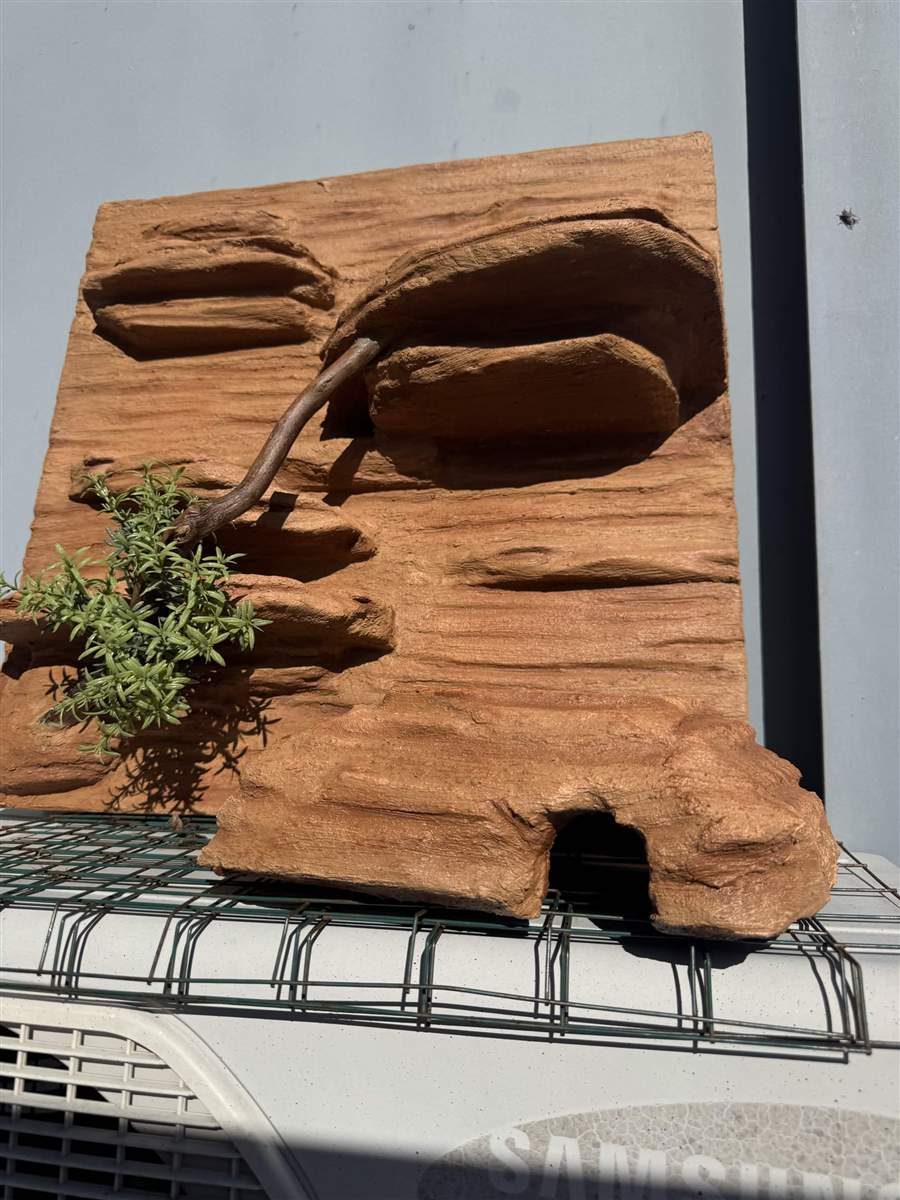
Real build · Children’s python · 2 ft × 2 ft
A blank wall became a whole little landscape.
Climbing shelves, resting pockets, an integrated branch and a surprise matching hide — shaped as one useful habitat rather than decoration pasted on at the end.